


Whilst a lot of people wish to live a healthy and active lifestyle, many struggle to integrate exercise into their everyday life. Nudging has been a popular approach to increase people’s exercise (see for example Goffe & Sundsmyr, 2017; or Bhattacharya et al, 2015) and it might be especially useful in a post-covid world.
Why walk to the Gym if you can just walk?
One form of exercise that most demographics are able to perform and benefit from is walking. Whilst it might not be as beneficial to one’s health as other forms of exercise, walking can be easily integrated into daily life and thus does not require much preparation or time. Due to its low intensity, walking might be especially well suited for older adults and there is evidence suggesting that it is the most popular and common form of physical activity for older adults (Feskanich et al., 2002). This popularity might have only increased since the Covid-19 pandemic and many cities have increased their walking infrastructure in order to increase resilience (Paydar & Fard, 2021). Since gyms and other exercise opportunities have been closed for extended amounts of time in numerous places around the globe, people needed to spontaneously adapt their exercise behavior. Many took on exercising from home
and google search results for exercise related content drastically increased (Ding et., 2020). The data suggests that this increase is so prominent, that it not only accounts for people switching their exercise habits to a pandemic-appropriate alternative, but that the interest in exercise itself has increased in the general population. Policy-makers and city planners might thus benefit from utilizing this new found interest in exercise to promote additional well-being and health benefits for the polulance.
Why drive to the Gym if you can walk there?
Policy-makers might also be interested in promoting walkability, as walking is an environmentally-conscious and sustainable mode of transport that can be increased through nudging (Klemschitz et al., 2020). Wernbacher et al. (2020) conducted a study in Austria (Graz) and discovered that the amount people walk, as well as their interest and awareness regarding the effects of walking, can be increased through digital and physical nudges that motivate participants to explore the city on foot. They also note that walking should be perceived as a genuine and healthy option for short distances (<3 km), and the first choice when covering small distances (<1 km).
A Nudge in the right direction?
“A nudge, as we will use the term, is any aspect of the choice architecture that alters people’s behavior in a predictable way without forbidding any options or significantly changing their economic incentives. To count as a mere nudge, the intervention must be easy and cheap to avoid. Nudges are not mandates. Putting fruit at eye level counts as a nudge. Banning junk food does not.”
– Richard Thaler & Cass Sunstein (2008)
Nudging as a method to elicit behavioral change receives numerous criticisms. Ewert (2017) for example argues that health-related nudges have three major drawbacks in comparison to more holistic approaches: they disregard structural behavioral prevention/encouragement, they enforce cultural homogeneity and people are predominantly viewed as nudge-consumers (nudgees), whilst other identities such as citizens receive less attention. These arguments can be partially diffused if the proposed nudge is embedded in a larger context that includes residents and city-planners in the process of designing a more walkable city. The nudges in the Wernbacher et al. (2020) study, for example, were more akin to an educational campaign and thus not hidden or operating in the dark. They therefore do not lend themselves to the same discussion about ethical concerns relating to people’s freedom that more hidden nudges frequently spark. Nudges can operate in plain sight and they can be both transparent and effective, as researchers such as Bruns et al. (2018) discovered. Additionally, nudges need not be expensive or extensive. A simple copy-paste prompt on how to exercise more or better can be enough to motivate people to do so by tapping into their innate motivation for goal achievement (Mehr et al., 2020).
Nudging in the wrong direction to promote walking
One can utilize transparent nudges to increase the amount people walk by offering them additional information on the walkability of an area. This can be achieved by installing signs that not only offer the shortest route to a certain destination, but also an extended route that people can take if they desire to walk a longer distance. The nudge can therefore be considered an informational nudge, a type of nudge that aims to change people’s behavior by only providing them with additional information that they can utilize in their decision making process if they so choose. Informational nudges are also frequently used to elicit certain types of social behavior (Bao & Ho, 2015) or improve people’s financial decision making (see for example Anderson & Robinson, 2018). In order to activate people’s desire to take a longer route, one can either appeal to their goal of a more pleasant, scenic or stimulating route or by highlighting the health benefits of walking. Both the attributes of a route (Joseph & Zmring, 2007), as well as knowledge on the health benefits of walking (Wernbacher et al., 2020) have been shown to influence people’s walking behavior.
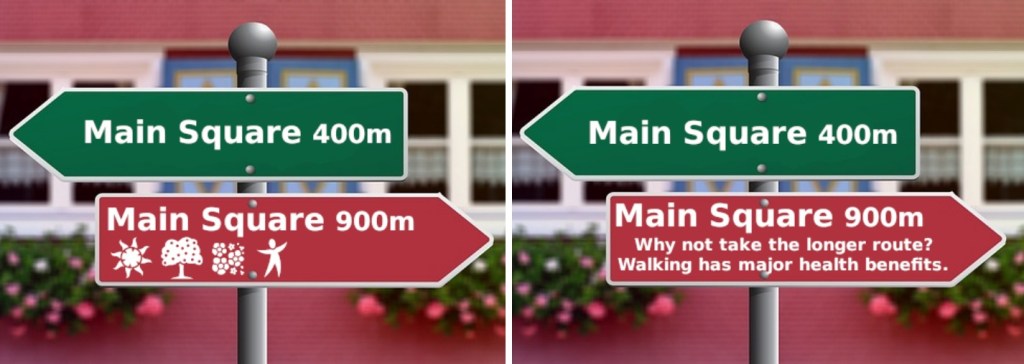
Once a city has adequate and enjoyable walking infrastructure, citizens might only need “a nudge in the right direction” to utilize additional walking paths out of their own volition. On the other hand, if a city is very car dependent and features low walkability, a nudge such as the proposed one cannot be effective. Nudging should therefore not be seen as the be-all-end-all, but instead as a part of a bigger plan of promoting healthy, walkable and sustainable cities and citizens.
See the two example images on this page. Which type do you prefer? Do you think a nudge such as this would get you or the people in your area to walk more.
References
- Anderson, A., & Robinson, D. T. (2018). Who feels the nudge? knowledge, self-awareness and retirement savings decisions. National Bureau of Economic Research.
- Bao, J., & Ho, B. (2015). Heterogeneous effects of informational nudges on pro-social behavior. The BE Journal of Economic Analysis & Policy, 15(4), 1619-1655.
- Bhattacharya, J., Garber, A. M., & Goldhaber-Fiebert, J. D. (2015). Nudges in exercise commitment contracts: a randomized trial. National Bureau of Economic Research.
- Bruns, H., Kantorowicz-Reznichenko, E., Klement, K., Jonsson, M. L., & Rahali, B (2018). Can nudges be transparent and yet effective?. Journal of Economic Psychology, 65, 41-59.
- Ding, D., del Pozo Cruz, B., Green, M. A., & Bauman, A. E. (2020). Is the COVID-19 lockdown nudging people to be more active: a big data analysis. British Journal of Sports Medicine, 54(20), 1183-1184.
- Ewert, B. (2017). Promoting health in schools: Theoretical reflections on the settings approach versus nudge tactics. Social Theory & Health, 15(4), 430-447.
- Feskanich, D., Willett, W., & Colditz, G. (2002). Walking and leisure-time activity and risk of hip fracture in postmenopausal women. Jama, 288(18), 2300-2306.
- Goffe, A., & Sundsmyr, S. (2017). Nudging people off of the couch. A nudge experiment on physical exercise in collaboration with SATS.
- Joseph, A., & Zimring, C. (2007). Where active older adults walk: Understanding the factors related to path choice for walking among active retirement community residents. Environment and Behavior, 39(1), 75-105.
- Klementschitz, R., Batiajew, V., & Roider, O. (2020, September). Behaviour Change towards Sustainable Mobility triggered by Nudging Initiatives. In SHAPING URBAN CHANGE–Livable City Regions for the 21st Century. Proceedings of REAL CORP 2020, 25th International Conference on Urban Development, Regional Planning and Information Society (pp. 75-85). CORP–Competence Center of Urban and Regional Planning.
- Mehr, K. S., Geiser, A. E., Milkman, K. L., & Duckworth, A. L. (2020). Copy-paste prompts: A new nudge to promote goal achievement. Journal of the Association for Consumer Research, 5(3), 329-334.
- Obuchi, S. P., Kawai, H., Ejiri, M., Ito, K., & Murakawa, K. (2021). Change in outdoor walking behavior during the coronavirus disease pandemic in Japan: A longitudinal study. Gait & posture, 88, 42-46.
- Paydar, M., & Kamani Fard, A. (2021). The hierarchy of walking needs and the COVID-19 pandemic. International Journal of Environmental Research and Public Health, 18(14), 7461.
- Thaler, R. H., & Sunstein, C. R. (2008). Improving decisions about health, wealth and happiness. Constitutional Political Economy, 19(4), 356-360.
- Wernbacher, T., Platzer, M., Schneider, J., Titze, S., Denk, N., & Pfeiffer, A. (2020, April). Walk Your City: Using Nudging to Promote Walking. In SHAPING URBAN CHANGE–Livable City Regions for the 21st Century. Proceedings of REAL CORP 2020, 25th International Conference on Urban Development, Regional Planning and Information Society (pp. 1009-1018). CORP–Competence Center of Urban and Regional Planning.
 Psyty Development